

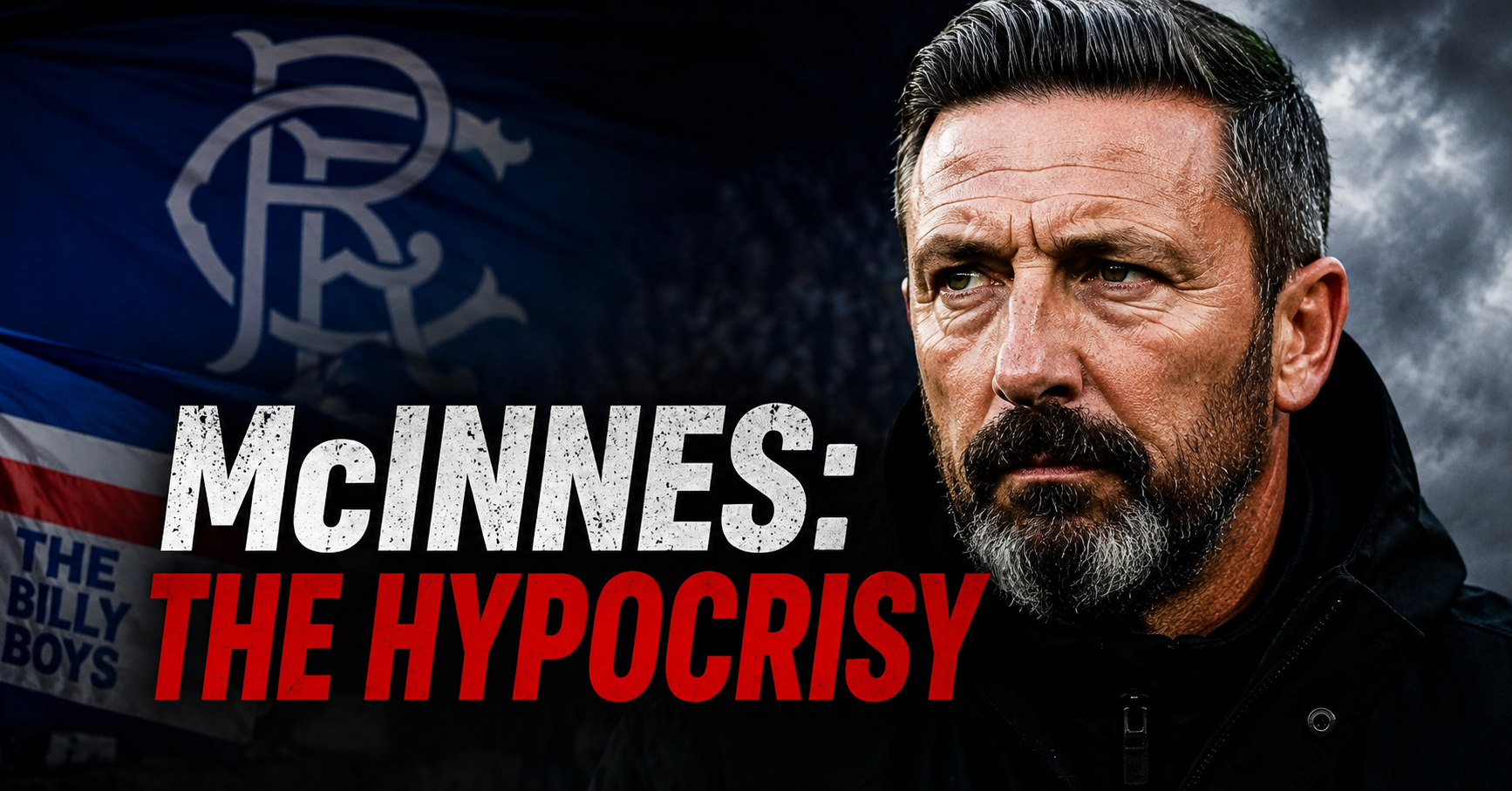
The Daily Record wants readers to applaud Derek McInnes for standing by Kyle Lafferty during his sectarian controversy. I can’t. Until McInnes properly addresses the resurfaced footage that appears to show him singing The Billy Boys—a song containing well-known sectarian lyrics—any attempt to portray him as the moral authority in this story rings hollow. If Scottish football is serious about confronting sectarianism, then everyone must be held to the same standard, regardless of the badge they wear or the position they hold.
Whether McInnes believes the footage reflects who he is today is a matter for him to answer. What is striking is the lack of sustained scrutiny compared with the treatment others have received in similar circumstances. Before newspapers portray him as the compassionate voice of reason, those questions deserve to be confronted rather than ignored.
The Daily Record‘s latest piece paints McInnes as the compassionate manager who put his arm around a player in his darkest hour. Kyle Lafferty praised McInnes’ “unique man-management”, saying he would “never forget” how his former manager supported him when he was “short on allies” after his sectarian slur controversy. According to Lafferty, McInnes stood by him when many others walked away.
Nobody would argue that a manager should never help a player rebuild their career after making serious mistakes. Football should allow for rehabilitation and second chances.
But that’s only half the story.
The question the Daily Record barely addresses is this: how can Derek McInnes be presented as the moral compass in Scottish football while longstanding questions remain about his own conduct?
Many supporters have seen the resurfaced footage that appears to show McInnes participating in a rendition of The Billy Boys, a song infamous for its anti-Catholic lyrics. That footage has fuelled accusations of hypocrisy whenever McInnes speaks publicly about standards, behaviour or respect within Scottish football.
Imagine if a newly appointed Celtic manager had historical footage emerge showing him enthusiastically singing a song advocating violence towards another community.
Would the Scottish media quietly move on?
Would politicians remain silent?
Would broadcasters ignore it?
Or would there be demands for apologies, investigations and accountability before he was even allowed through the door?
Many Celtic supporters believe they already know the answer.
That perception of double standards is impossible to ignore.
The issue stretches beyond one individual. The Billy Boys continues to be heard regularly at Rangers matches despite years of condemnation of sectarianism in Scottish football. Yet meaningful action still appears inconsistent, leaving many to question whether anti-Catholic sectarianism is treated with the seriousness it deserves.
If chants targeted Black people, Jewish people, Muslims or any other minority in the same way, it is difficult to believe they would continue to be tolerated in modern football. That comparison raises uncomfortable questions about why sectarianism aimed at Catholics continues to provoke so much less urgency.
This is about consistency. Public figures cannot expect to occupy the moral high ground while avoiding legitimate questions about their own past. Equally, newspapers should not present flattering portraits of influential figures without also acknowledging the context that many supporters believe is central to the story.
Scottish football cannot claim to be serious about eradicating sectarianism if the standards applied depend on the individual or the club involved. Until those standards are applied equally to everyone, accusations of hypocrisy will continue to overshadow the game’s credibility, and supporters will continue to question whether justice in Scottish football is truly blind or merely selective.
[…] worked closely with Derek McInnes during their time together at Hearts. That means he has first-hand knowledge of how McInnes […]
[…] usual suspects rolled out one after another — Ally McCoist, Kris Boyd, Derek McInnes, Keith Jackson, Jim White, Tom English, BBC Scotland, the Daily Record, politicians, Police […]