
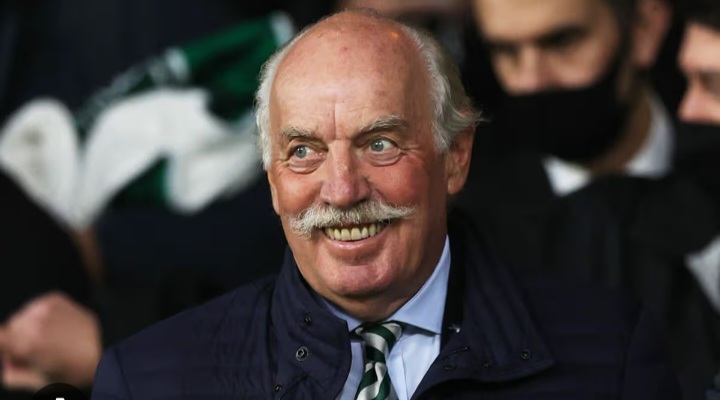
When Dermot Desmond became Celtic’s principal shareholder in September 1999, the world looked very different.
The Nokia 3210 was revolutionary. Mobile phones had tiny monochrome screens, physical buttons, no cameras, no internet and no apps. They were designed for one purpose: making calls.
Today, those same phones are relics.
The modern smartphone is an AI-powered computer, television studio, business hub and entertainment centre all rolled into one. Every major technology company understood one simple truth.
Evolve or become obsolete.
That same lesson applies to football.
The problem for Celtic is that, after 27 years as the club’s dominant influence, Dermot Desmond increasingly appears to represent yesterday rather than tomorrow.
Football has transformed beyond recognition since 1999.
The Champions League has become a global commercial powerhouse. Recruitment is driven by analytics and elite scouting networks. Clubs have become worldwide media companies producing content around the clock. Stadiums have become year-round entertainment destinations generating income every day of the week.
Yet Celtic often look like a club still operating with the mindset of a quarter of a century ago.
That ultimately comes back to one man.
Dermot Desmond.
He is not the owner of Celtic. He is the principal shareholder. That distinction matters. Celtic belongs to all of its shareholders and its board has legal duties to the club as a whole, not to any individual. Yet for almost three decades it has been widely accepted that no major strategic decision is taken without Dermot Desmond’s approval.
That concentration of influence inevitably brings responsibility.
It also demands accountability.
Instead, supporters see the opposite.
The man who reportedly holds the greatest influence over Celtic’s future is rarely seen, rarely heard and rarely answers questions directly.
He does not regularly attend Annual General Meetings where shareholders deserve answers.
He seldom explains the club’s long-term strategy.
He almost never publicly addresses supporters.
Yet his influence over the biggest decisions remains enormous.
That is not modern leadership.
That is remote control.
Perhaps the greatest criticism of Dermot Desmond’s era is not what he has done.
It is what he has failed to do.
Fergus McCann handed him one of Britain’s finest football stadiums.
Twenty-seven years later, what transformational project bears Dermot Desmond’s fingerprints?
Where is the world-class museum that was once discussed?
Where is the hotel that would have transformed Celtic Park into a destination seven days a week?
Where is the commercial district surrounding the stadium?
Where is the expansion towards 80,000 seats that supporters have debated for years?
Where is the bold vision that should define one of Europe’s biggest clubs?
Too often there is only silence.
Too often there is only another promise that disappears into the distance.
Maintaining Fergus McCann’s achievements is not the same as creating your own legacy.
The same lack of ambition can be seen across the football operation.
Recruitment repeatedly feels reactive instead of proactive.
Every transfer window seems to become an exercise in delay, caution and hesitation while rivals across Europe complete deals with far greater urgency.
Supporters ask the same questions every summer because the same problems keep returning.
That is not bad luck.
That is a pattern.
Then there is Celtic’s media operation.
This should be one of the club’s greatest strengths.
Millions of supporters live outside Scotland.
Modern clubs understand that engaging those supporters every single day is no longer optional—it’s essential.
Yet Celtic Player continues to leave many supporters underwhelmed.
Meanwhile, Paul John Dykes and A Celtic State of Mind consistently produce compelling daily content that captures the imagination of supporters with only a fraction of the resources reportedly available to the club.
It raises an obvious question.
If independent creators can achieve so much, what exactly is a professional media department of around 30 people producing?
This isn’t simply about videos.
It reflects a deeper issue.
Innovation appears to have been replaced by complacency.
The world refuses to stand still.
Technology doesn’t stand still.
Football doesn’t stand still.
Successful businesses don’t stand still.
Yet Celtic too often appear content to do exactly that.
Perhaps the most alarming aspect of all is the sense that fresh thinking has disappeared entirely.
Dermot Desmond will turn 76 next month.
Age alone is not a criticism. Vision, ambition and leadership are not determined by birthdays.
But every leader eventually reaches the point where fresh ideas become essential.
After 27 years, it is entirely reasonable for supporters to ask whether one individual can still possess the same drive, energy and understanding of a football industry that has changed beyond recognition since 1999.
That is not disrespect.
It is reality.
The comparison with the Nokia 3210 could hardly be more appropriate.
A phone that was revolutionary in 1999 would be hopelessly outdated today.
Not because it was badly designed.
Because the world moved on.
Football has moved on too.
The fear among many supporters is that Celtic’s leadership has not moved with it.
Last year’s AGM only reinforced that feeling. Rather than hearing directly from Dermot Desmond, supporters instead heard his son Ross defend the family’s position and criticise sections of the support.
For many fans, it symbolised a leadership increasingly disconnected from legitimate questions about the club’s direction. Criticism of strategy is not the same as personal abuse, and supporters are entitled to expect transparency from those with significant influence over Celtic’s future.
Nobody can deny Dermot Desmond’s contribution to Celtic’s stability or the success the club has enjoyed during much of his time as principal shareholder.
History should record those achievements fairly.
But football does not reward sentiment.
It rewards innovation.
It rewards courage.
It rewards leaders willing to challenge themselves before circumstances force change upon them.
Twenty-seven years is an extraordinary period for one individual to shape a football club.
For an increasing number of Celtic supporters, the conclusion has become unavoidable.
The game has changed.
The world has changed.
Celtic must change too.
And that begins with recognising that after nearly three decades at the top, Dermot Desmond’s era has reached its natural conclusion. Fresh leadership, fresh ideas and fresh ambition are no longer desirable—they are necessary if Celtic are to realise the full potential that has been waiting for far too long.
[…] Dermot Desmond is a billionaire, yet there is no evidence of him personally funding Celtic’s football operation. […]
[…] deals over the line? Or are their hands tied because every significant decision has to be run past Dermot Desmond before anything can […]
First up…could someone tell MON that DD is NOT the owner of the Club…What a riddy that was…As for the elderly men in grey suits … ( and I’m 80 btw so that’s allowed)..they are not fit for purpose and need replaced…However, when they are able to announce a 99.5 % uptake in season tickets…then maybe…just maybe…it looks like a vote in confidence in them….Just sayin’.
Exactly.
The odious Desmond and his malignant cabal of corporate greed and austerity fc will not step away from Celtic, why the hell should he when every year the season ticket holders have given carte blanch to do what he wants which is keep our money,Stop giving them your money or you are complicit in the destruction of our club